Wednesday, September 19, 2012

Report on the 'Maria Challenge' unveiling at the Hunters Hill Quilters 30th Birthday Party

On Thursday the 13th of September 2012, I was lucky enough to be one of those invited to attend the Hunters Hill Quilters 30th birthday celebrations lunch. The guest speaker was Margaret Rowe, author of the Quilt Challenge series. Dr Annette Gero also brought alone one of her recent finds to show us.

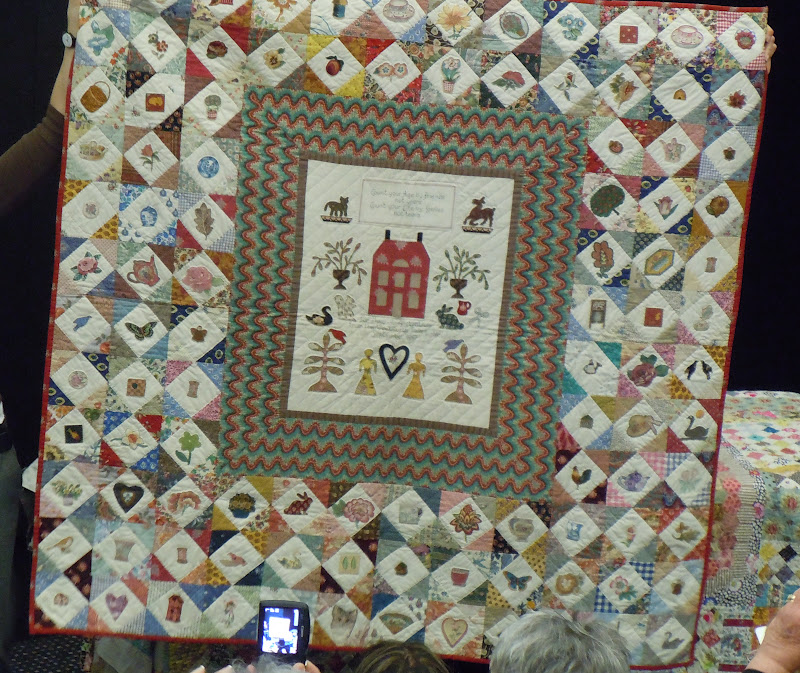
Thirty-nine quilters accepted the 'Maria Challenge' and their results were unveiled at the meeting. Each person spoke about how they had approached the challenge, describing the quilt making process they followed and then spoke about the life of the convict woman they had been assigned. If they could not research their assigned convict's life, some created wonderful life stories for her- some hilariously on the spot. After judging had finished, the president handed out prizes for the best coverlets along with a prize for the best storyteller.
maria-challenge130912-113
See https://sites.google.com/site/huntershillquilters/maria-challenge for exact details of the challenge, a photograph of the winning coverlet made by Lindy Messenger and photographs of the 39 entries.

Margaret Rowe then spoke about her self publishing journey, including how her four Australian  challenge quilt novels came to be written. See http://margaretarowe.blogspot.com.au/ for the story of her journey, her current work and contact details.
 [Margaret+A+Rowe+author.JPG]
There are 4 books in the "Australian Challenge Quilt Series" -
The Maria Challenge Quilt
The Elizabeth Challenge Quilt
The Caroline Challenge Quilt
The Amelia Challenge Quilt

They are all paperback and $24.95 each. Margaret does not charge postage for private orders within Australia, but overseas postage is unfortunately $10 per book. You can contact her direct by email at rowekeys01@optusnet.com.au and she takes payments by cheque, cash or direct deposit.
 
Finally Dr. Annette Gero showed one of her latest acquisitions which was found in a Sydney junk shop 15 years ago. It is a simple hexie quilt that has the date '1811' and a name, which she thinks belongs to a convict woman, embroidered on it. Annette believes that the fabrics are correct for that time and and she is continuing further research on it. 

Liz Bonner


Monday, September 17, 2012

Report on Dianne Finnegan’s talk to QSG of NSW on the Soft Furnishings Project for the Historic Houses Trust properties


On Saturday 15th of September 2012, Dianne Finnegan gave a wonderful presentation on the Soft Furnishings Project she has been leading since 2008 at Elizabeth Bay House in Sydney. Dianne was drawn to this project after health problems meant that she could no longer quilt. She has always been fascinated with the relationship people have to their quilts and other furnishings in their homes especially how these objects are used to denote wealth, status, taste, and notions of family. As well Jasper Morrison and Naoto Fukasawa’s notion of ‘super normal design’ (everyday objects that really make a difference in our living environment but don’t grab our attention) intrigues her.

Dianne spoke of Alexander Macleay, the owner and builder of Elizabeth Bay House, his life and the house itself. She quoted from the diary of his unmarried daughter, Fanny, who provided the inspiration and model for how they have worked on this project. If an area of textiles cannot be seen, then a sewing machine is used.  If it is cold, then they move the table and chairs close to the open fire and if the light is low, then they move to the window for more light. At all times they have been mindful of budget restrictions. Their design inspiration has come from images in books of that time and the wonderful HHT’s Caroline Simpson library and research collection.

Dianne broke her talk into the different areas of the project they had worked on – the bed furnishings, hangings and coverings, the window dressings including Holland blinds, fringes and silk screens, and the other oddities they have been called upon to sew (skin rugs, baize table cloths, aprons for use by visiting school children and knitted doilies for the dining table). They are now investigating Berlin work, making linens to fill cupboards, and will start on making rag rugs for the house. They hope to soon start a similar soft furnishings project for Elizabeth Farm.

On her guided tour, Dianne spoke of the problems they will have in freezing a bale of hay to restuff one of the mattresses in the main upstairs bedroom. We also saw close up the problems her group of sewers worked through in making the bed hangings on the campaign bed. And we admired the beautiful knitted bed covers.

In the Drawing room, the curtains were last replaced in the 1980s so Dianne consulted her reference books to create ones in a more appropriate style. In the process they discovered that the original gilt pelmets had been sold to Old Government House so these were copied and replaced.  The bullion fringe was reused but a knitted fringe had to be made for the new curtains. They also made pleated silk screens for the piano and lining cupboards.


In the Dining room, because they could not afford lace curtains, Elizabeth Wright made a design for them to copy, which they then embroidered by hand – but only after their workmanship met Elizabeth’s exacting standards.


Monday, September 3, 2012

Dr Annette Gero 11th September Talk at Penrith Booked Out

Unfortunately, the talk that Dr Annette Gero is giving at the Penrith Civic Centre on Tuesday the 11th of September 2012 in conjuction with the Nepean District Historical Society's Library History Week display was booked out 2 weeks ago. There are currently no places left nor is there a waiting list.

Thursday, August 30, 2012

Updated details for Dr Annette Gero and Karen Fail talk on 12th September 2012

The Powerhouse Museum is organising to have Aunt Clara's quilt and their military quilt at the the How the Power of Quilting Connects Communities seminar on the 12th of September 2012. They are the subject of talks that Karen Fail and Dr Annette Gero are giving at the Powerhouse Discovery Centre at Castle Hill.
See the previous entry in May 2012 for details of this event. The programme is available at
http://historycouncilnsw.org.au/history/post/how-the-power-of-quilting-connects-communities/

Thursday, August 23, 2012

Annette Gero talk for the Nepean District Historical Society on 11th September 2012012

In conjuction with the Nepean District Historical Society's Library History Week display Dr Annette Gero will be giving a talk on Australia's quilt heritage and exhibiting some of the antique quilts featured in her book "The Fabric of Society: Australia's Quilt Heritage from convict times to 1960".

As part of their Antique Quilt Roadshow, they invite participants to bring along their own antique quilts, which Dr Gero will be happy to assess on the day.

When: Tuesday 11th September 2012
Where: Library Theatrette Penrith Civic Centre
Cost: $5 including light refreshments.
Bookings essential on 4732 7891

For more details see http://www.nepeanhistoricalsociety.org.au/imgedit/show_news1.php?id=1

Wednesday, August 8, 2012

Dianne Finnegan QSG of NSW talk on Saturday 15th September at Elizabeth Bay House


This talk for the Quilt Study Group of NSW will take place at 2pm on Saturday the 15th September 2012 at Elizabeth Bay House, 7 Onslow Ave, Elizabeth Bay.
Elizabeth Bay House. Photograph (c) Patrick Bingham Hall
Dianne Finnegan has made quilts for nearly thirty years and along the way has been president of The Quilters' Guild NSW for the Bicentenary, exhibited internationally, curated exhibitions, explored the history of Australian quilts, written books and articles, fundraised, and travelled around the world teaching.
Currently, she is working with the Historic Houses Trust on their Soft Furnishings Project, restoring and replicating textiles at Elizabeth Bay House. 
For this event, Dianne will give her presentation on the Soft Furnishings Project followed by afternoon tea. Then there will be a guided tour of the house by one of the regular guides and a tour of the textiles with Dianne.
Entry to Elizabeth Bay House will be half price for this event  - $4 or Concession - $2; Members of HHT- Free. There is also a fee to the Quilt Study Group of NSW for the talk. This is $5 for  Quilters' Guild of NSW Inc. Members and $15 for non-Guild members.
BOOKINGS ARE ESSENTIAL. Please email Karen Fail at karenvfail@gmail.com  to secure a place at this event.
You are advised not to bring your car. For details on how to get to Elizabeth Bay House, see http://www.hht.net.au/museums/ebh

Friday, July 27, 2012

Report on Margaret Sampson George’s QSG of NSW talk on Medallion Quilts


On Saturday the 21st of July 2012, Margaret Sampson George spoke for the Quilt Study Group of NSW about Medallion or Frame Quilts. There were 68 in the audience in the Target Theatre at the Powerhouse Museum who came to hear Margaret Sampson George talk about her introduction to sewing and quilting, her love of medallion quilts, examine some quilts in detail and then to see examples of her work and her students’ work. Margaret discovered quilt making through her contact with the craft magazines that her US service wife friends read when living in Alice Springs. After making her first quilt, a log cabin, and then moving to Penrith, she and a friend enrolled in a patchwork class run by the Embroiderers’ Guild of NSW. The teacher, Audrey McMahon, allowed them to make 4 blocks, instead of a glasses case, and introduced them to Avril Colby’s “Patchwork” (her bible still) and the Lady's Circle Patchwork Quilts magazines and the Quilter's Newsletter Magazines.

A year later, she started teaching but saw there was a need for commercial suppliers of metal templates and quilting frames. She encouraged a local company to make these – thus beginning the successful start of JH Bonwick & Co’s quilting products manufacture. Now Margaret teaches whatever people want to do – “repeat blocks are not me”, she said. This is why medallion quilts have interested her – they are quirky, eccentric and traditionally are not made from a pattern but evolve. Her detailed examination of Joanna Southcott’s quilt (http://www.rammtimetrail.org.uk/#/period-17//object-1011) which was stitched in the centre with her own hair, best exemplifies what attracts Margaret’s interest.

Margaret then discussed the historic reasons for the popularity of medallion quilts, the development of fabrics from the 1500s onwards (especially the quilt centres based on pastoral, floral, military or commemorative panels) and the importance of medallions for commemorating important dates in the makers’ lives (such as the New Zealand Martha Quilt – see the story of this wonderful quilt at - http://roxborogh.com/Marthasquiltimages/565K%20Martha%27s%20Quilt%201%201%2007.pdf).

She finds it wonderful that there are no two identical frame quilts yet found and loves the odd ones – those that are not “oversized mathematical behemoths”. She doesn’t believe that there is a mathematical formula applicable but can see how the Fibonacci principles could help when designing the width of the frames. She now loves renovating her centres to take advantage of new, brighter fabrics.

Margaret then took us through her quilts and those of her students. She started with the One Day Quilt she made in 1992.

This is her 'Not the Levens Hall' quilt.

Here are 2 centres inspired by the Jane Pizar Irish medallion quilt which is held at the Cheltenham Museum. The original can be viewed at http://www.bridgemanart.com/search?filter_text=pizar&x=0&y=0 (Barbara Brackman has a more detailed examination of the quilt on her blog). Marg discovered the quilt when she saw an ad for the museum in an 'English Country Living' magazine. The first example was made by one of Marg's students and the second one is Marg's version.


And this is the medallion quilt she made from available fabrics and sewed under the curfew during the coup when living in Fiji.

Margaret then shared a number of quilts her students have made including some made by Gay Drummond and Maree Spencer, who were in the audience. Thank you for letting us see your wonderful quilt tops.


And this is the last quilt Marg showed us. A group of her students made it for her. She never uses Visoflex, so for fun they used it when making the blocks.