Friday, July 27, 2012

Report on Margaret Sampson George’s QSG of NSW talk on Medallion Quilts


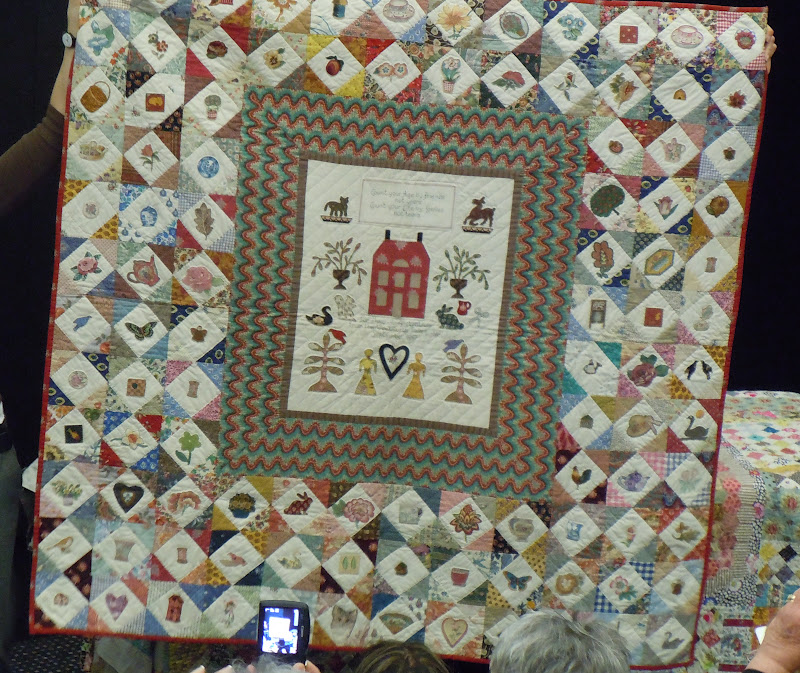
On Saturday the 21st of July 2012, Margaret Sampson George spoke for the Quilt Study Group of NSW about Medallion or Frame Quilts. There were 68 in the audience in the Target Theatre at the Powerhouse Museum who came to hear Margaret Sampson George talk about her introduction to sewing and quilting, her love of medallion quilts, examine some quilts in detail and then to see examples of her work and her students’ work. Margaret discovered quilt making through her contact with the craft magazines that her US service wife friends read when living in Alice Springs. After making her first quilt, a log cabin, and then moving to Penrith, she and a friend enrolled in a patchwork class run by the Embroiderers’ Guild of NSW. The teacher, Audrey McMahon, allowed them to make 4 blocks, instead of a glasses case, and introduced them to Avril Colby’s “Patchwork” (her bible still) and the Lady's Circle Patchwork Quilts magazines and the Quilter's Newsletter Magazines.

A year later, she started teaching but saw there was a need for commercial suppliers of metal templates and quilting frames. She encouraged a local company to make these – thus beginning the successful start of JH Bonwick & Co’s quilting products manufacture. Now Margaret teaches whatever people want to do – “repeat blocks are not me”, she said. This is why medallion quilts have interested her – they are quirky, eccentric and traditionally are not made from a pattern but evolve. Her detailed examination of Joanna Southcott’s quilt (http://www.rammtimetrail.org.uk/#/period-17//object-1011) which was stitched in the centre with her own hair, best exemplifies what attracts Margaret’s interest.

Margaret then discussed the historic reasons for the popularity of medallion quilts, the development of fabrics from the 1500s onwards (especially the quilt centres based on pastoral, floral, military or commemorative panels) and the importance of medallions for commemorating important dates in the makers’ lives (such as the New Zealand Martha Quilt – see the story of this wonderful quilt at - http://roxborogh.com/Marthasquiltimages/565K%20Martha%27s%20Quilt%201%201%2007.pdf).

She finds it wonderful that there are no two identical frame quilts yet found and loves the odd ones – those that are not “oversized mathematical behemoths”. She doesn’t believe that there is a mathematical formula applicable but can see how the Fibonacci principles could help when designing the width of the frames. She now loves renovating her centres to take advantage of new, brighter fabrics.

Margaret then took us through her quilts and those of her students. She started with the One Day Quilt she made in 1992.

This is her 'Not the Levens Hall' quilt.

Here are 2 centres inspired by the Jane Pizar Irish medallion quilt which is held at the Cheltenham Museum. The original can be viewed at http://www.bridgemanart.com/search?filter_text=pizar&x=0&y=0 (Barbara Brackman has a more detailed examination of the quilt on her blog). Marg discovered the quilt when she saw an ad for the museum in an 'English Country Living' magazine. The first example was made by one of Marg's students and the second one is Marg's version.


And this is the medallion quilt she made from available fabrics and sewed under the curfew during the coup when living in Fiji.

Margaret then shared a number of quilts her students have made including some made by Gay Drummond and Maree Spencer, who were in the audience. Thank you for letting us see your wonderful quilt tops.


And this is the last quilt Marg showed us. A group of her students made it for her. She never uses Visoflex, so for fun they used it when making the blocks.

Sunday, July 1, 2012

Report on Judy Hooworth’s QSG of NSW talk on 26th May 2012


Judy Hooworth gave an extensive talk to the QSG of NSW at the Powerhouse Museum in May. She broke the talk into three topics. The first section of her talk covered the history of ‘The New Quilt Exhibition’. The second section covered the thoughts and recent works of selected current contemporary quilters who have exhibited their works in ‘The New Quilt’ exhibition or its successor.
And the last part of Judy’s talk was the story of her quilting journey.

Quilting really took off in Australia in 1981. By the time Judy Hooworth and Anna Brown were on the Guild’s committee in 1992, they knew that recognizably Australian quilts were being made and it was time to also see quilts as ‘works of art’, not just as bed coverings. The committee accepted their proposal to start ‘The New Quilt Exhibition’ to showcase such quilts, so they took some of their own representative quilts to a list of museum and art galleries to gather support. Michael Pursche, then director of the Manly Art Gallery and Museum (and who was also in the audience), agreed to provide the venue for the exhibition. The benchmark for the first show was USA’s Quilt National, and the first catalogue produced for The New Quilt Exhibition has ensured continuing recognition of the event. Judy showed us the cover of every catalogue produced and took us through the themes and notable developments shown by quilters at each exhibition. She noted that while one third of the entries in the first exhibition had some surface design and two thirds used commercial fabrics, in the most recent exhibition 15 of the 19 exhibitors made their own fabrics. She encouraged all of us to submit proposals for future exhibitions because it is important to our work to ask ourselves three important questions: ‘What are we making? Why? And what have I made before?’ There are no prizes given but the reward is the privilege of being accepted into the Exhibition. Judy’s final piece of advice: ‘Take courage to submit a proposal’.


For the second section of her talk, Judy approached quilt artists who had exhibited in The New Quilt Exhibitions and asked them to provide her with digital images of their recent and earlier works, and to tell her what was the highlight of their career so far. It was remarkable to see how their quilts had changed and to hear the highlights. Those who responded included Yvonne Line, Barbara Macey, Pamela Fitzsimons, Alison Muir, Alveena Hall, Dianne Firth, Greg Somerville, Susan Matthews, Glennis Mann, Carolyn Sullivan, John Parkes, Anna Brown and Sue Cunningham.

In the final section of her talk, Judy took us through her artistic journey in textiles, her awards and the publications to which she has contributed. She started stitching with Noreen Dunn in the Cottage Quilters group in 1981. In 1985 they joined forces to start a business, Quiltek, and had a stall at the Craft Expos from 1985 to 1987. They both taught and sewed on consignment. Judy said she ‘concentrated on colour, Noreen on maths’.

Judy has always worked on series of quilts and showed us examples from every one of them. She started with her 1986 Double Homage series, inspired by Amish quilters, which marked the start of her career as a contemporary quilt maker.

By 1993 her fascination with the log cabin series led to her first entry into USA’s Quilt National.

In 1995 and 1997, the red, white, yellow and black colours in road barriers sparked her ‘Urban Landscapes’ series.

Her move from Terrey Hills to Morriset in 2004 led to the latest change in Judy’s work. As she initially had no studio or commercial fabrics to use, she started experimenting with plain white fabric torn into strips, layered, slashed and painted.


Her inspiration comes from nearby Dora Creek and she is now back to working with simple pieced and collaged quilts. When she lost her husband three years ago, she started work on her latest quilts – the Black Water series – which are hand painted, monoprinted, discharge-dyed and worked with oil pastels on the top of the fabrics.

Cancellation of Dr Annette Gero's talk on 11th August 2012 for the National Trust Parramatta

Unfortunately the 11th August talk by Annette Gero for the National Trust Parramatta on 'The Fabric of Society' and the Frederica Josephson coverlet has been cancelled. It will be rescheduled to a date in 2013.

Wednesday, June 20, 2012

Margaret Sampson George's talk to QSG of NSW on 21st July 2012

Come along to hear Margaret Sampson George talk to the Quilt Study Group of NSW about Medallion quilts. She will also show us her quilts and describe how they have changed over the years.

Margaret stated - "Medallion" style quilts have always held a great fascination for me. From the simple to the sublime, from 200 years ago to the present day, they can provide lessons in restraint or lessons in complexity. My talk will attempt to gain an insight into the reasons behind their construction and therefore into the lives of the women who made them.


Please join us in the Target Theatre at the Powerhouse Museum in Sydney at 2pm on Saturday the 21st of July. There is no entry fee to the Powerhouse Museum if you are coming to the talk. Guild members pay $5 and non-Guild members $15 to attend. Afternoon tea is provided. Please bring along your own medallion quilts for show and tell after Margaret's talk.

Annette Gero talk for the National Trust Parramatta on 11th August 2012

 
UNFORTUNATELY THIS TALK HAS BEEN CANCELLED. IT WILL BE HELD AT A FUTURE DATE TO BE DETERMINED BY THE NATIONAL TRUST PARRAMATTA IN 2013.

The Fabric of Society: the story of our ancestors told through the quilts they made, both men and women.
 A talk by expert historian and passionate collector of historic Australian quilts, Dr. Annette Gero.
Dr Annette Gero, historian and author of “The Fabric of Society - Australia's Quilt Heritage from Convict Times to 1960” has been documenting and collecting historic Australian quilts since 1982. She curated a stunning exhibition shown at Old Government House in 2000. 

The thread that holds the patchwork of Australian history together is that every story told includes the making of a quilt. Each story draws on women's and men's memories, diaries, their letters to relatives, official records, and newspaper and magazine articles reflecting current domestic influences. Surprisingly, it has recently been uncovered that many men made quilts, both during the wars and during the Depression. Some wonderful examples will be shown. In addition, on display during the talk will be an exact replica of a coverlet held in the National Trust collection. The original was made by Frederica Josephson and the replica was beautifully recreated by The Quilt Study Group of NSW. Dr Gero has found out some exciting new stories about the maker of the coverlet.
Replica of the Frederica Josephson coverlet

Dr Gero will have copies of her book "The Fabric of Society - Australia's Quilt Heritage from Convict Times to 1960” ( which is fast running out)  for sale (cash or cheque only please).
Saturday 11 August, from 2.30 pm
Parramatta National Trust
Burnside Public School Hall, Masons Drive, North Parramatta 
Talk begins at 2.30,   $5 donation
Free parking is available.

Saturday, May 26, 2012

Historic NSW Hexagon Quilt Top Unearthed

The Quilt Study Group of NSW has a fascinating request: to identify the maker of a lovely half-inch hexagon quilt top. The owner is a 90 year old. She did not make it but she believes it was made by a member of her family, which has links to the families of NSW Governor Philip Gidney King and the retailer David Jones.


The hexies are backed with papers which could help with this identification.

The owner would like it to go to an institution where it can be seen and admired, possibly the Powerhouse Museum. If we can identify the maker this would be a great bonus. The QSG of NSW is keen to take on this project and we will start with a debate on the thorny question: what should be done with an item such as this? Watch this space for developments.


Friday, May 25, 2012

Annette Gero and Karen Fail talk for the Powerhouse Museum History Week in September

As part of the 'Quilts and Communities Seminar' that is being held as part of History Week at the Powerhouse Discovery Centre, Castle Hill,  Annette Gero and Karen Fail have been asked to talk   about two of the quilts in the Museum's collection that they have studied. The talk will be held on Wednesday the 12th September 2012 at Castle Hill.


Karen will talk about  Aunt Clara's quilt. This beautiful embroidered patchwork quilt is named 'Aunt Clara's quilt' for Mrs Clara Bate (nee Hughes). Family history suggests that Clara worked on the quilt all her life and that its imagery reflects both her daily life and its significant events. See http://www.powerhousemuseum.com/collection/database/?irn=259537 for more details.
Annette will talk about military uniform quilts in the Powerhouse's collection.
The theme for History Week is 'Threads'.

The seminar is a unique event that will be held at the Powerhouse Discovery Centre, 172 Showground Road, Castle Hill. It will look at the power of quilts to mobilise and connect communities and will include a range of professional speakers and case studies. The seminar is perfect for museum professionals working with collections and communities, as well as those interested in textiles and museum collections.

See http://historycouncilnsw.org.au/history/post/how-the-power-of-quilting-connects-communities/ for more details.

Update on booking details: You do need to book for this event for catering purposes and you cannot pay for this at the Powerhouse in Ultimo. There is now a surcharge for credit cards used for admission costs which range from .4% to 2.75% depending on which card you use. See
http://castlehill.powerhousemuseum.com/pdf/events/Connecting_Communities_Seminar_Flyer.pdf
for more details.